Data Humanism
16.07.2026
Often, data is viewed as a mathematic logical approach to understanding reality. However, looking through the lens of humanism, it is possible to recenter this perspective and understand data as flawed and personal. Yes, data can be used to predict weather, display statistically accurate geographical information, or any other technical justification. But it can also be used to understand your own lived experience. When we take data away from computers and generate it manually, more can be revealed. Boxes in a form don’t need to be filled in, because data isn’t always a spreadsheet. Sometimes data is a story or a brain dump. It is everywhere and constantly being created but not tracked. For example: how many doors do you walk through every day? The easiest way to unpack this question is to use a notebook and jot down every instance in which you walk through a door. You can add the time, type of door, and any other information you find relevant. It’s quite mundane, but this philosophy can be stretched beyond doors into any aspect of your own life that you want to understand better.
For my main project in Infoklasse, I adapted my interest in art museums into a study in which I gathered data on the people observing art. Most of my collected data was subjective. I counted their engagement in my head: one Mississippi, two Mississippi, etc. I didn’t have a stopwatch to get an exact measurement and at the end of the day, this wasn’t a scientific experiment, but a personal one based on my own curiosity. I also wanted to see how far the people would stand from the art, but I couldn’t exactly pull out a tape measure and find the exact number to the closest millimeter. Instead, I used estimation and rounded to the nearest half meter. Based on my studies, the average person looks at a piece of artwork for seven seconds, so I did not have much time to write down the information I need from each person. Yes, it is possible to write a code that uses some sort of visual input and calculates these numbers for me, probably more accurate than I can estimate. But this takes away the fact that I sat in each museum for two hours at a time and watched how different people experienced their visit. I did not want to gather data on 1000 people and come up with a scientific hypothesis. I wanted to slow down and watch, learning things along the way. If my method was automated, I wouldn't have noticed couples holding hands in front of a romantic painting or seen how an elderly man took photos of tiny details in an art piece. I wouldn’t have experienced the data collection that is just as important as the data itself.
Yes, my method is flawed in many ways, because the data isn’t objective. But the data is how I personally understand the world, and that can be just as important in some regards. Not all data needs to be put into a census graph. It can also be put into artwork and made beautiful because it is an observation of life, just as a still life painting would be. The artist and designer who inspired much of my work with data humanism is Giorgia Lupi, who coined this term in her Data Humanism philosophy.
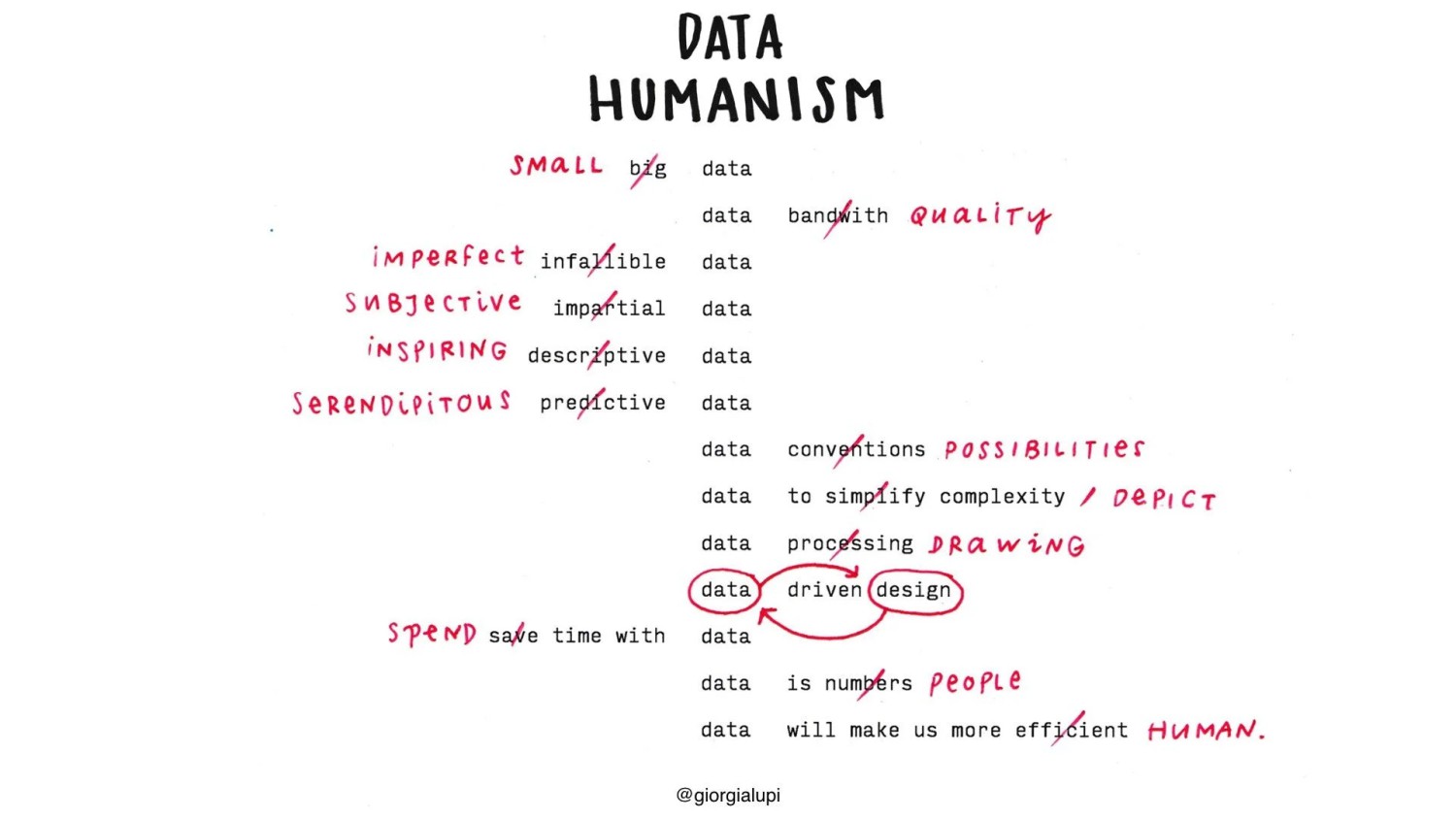
Giorgia Lupi
A project conducted by Lupi and fellow designer and friend, Stefanie Posavec, titled Dear Data was a year’s long endeavour to understand themselves and each other better through the lens of data. Every week they would choose a topic, track the required data, and create a visualization of that data on a postcard, which was sent across countries to exchange.
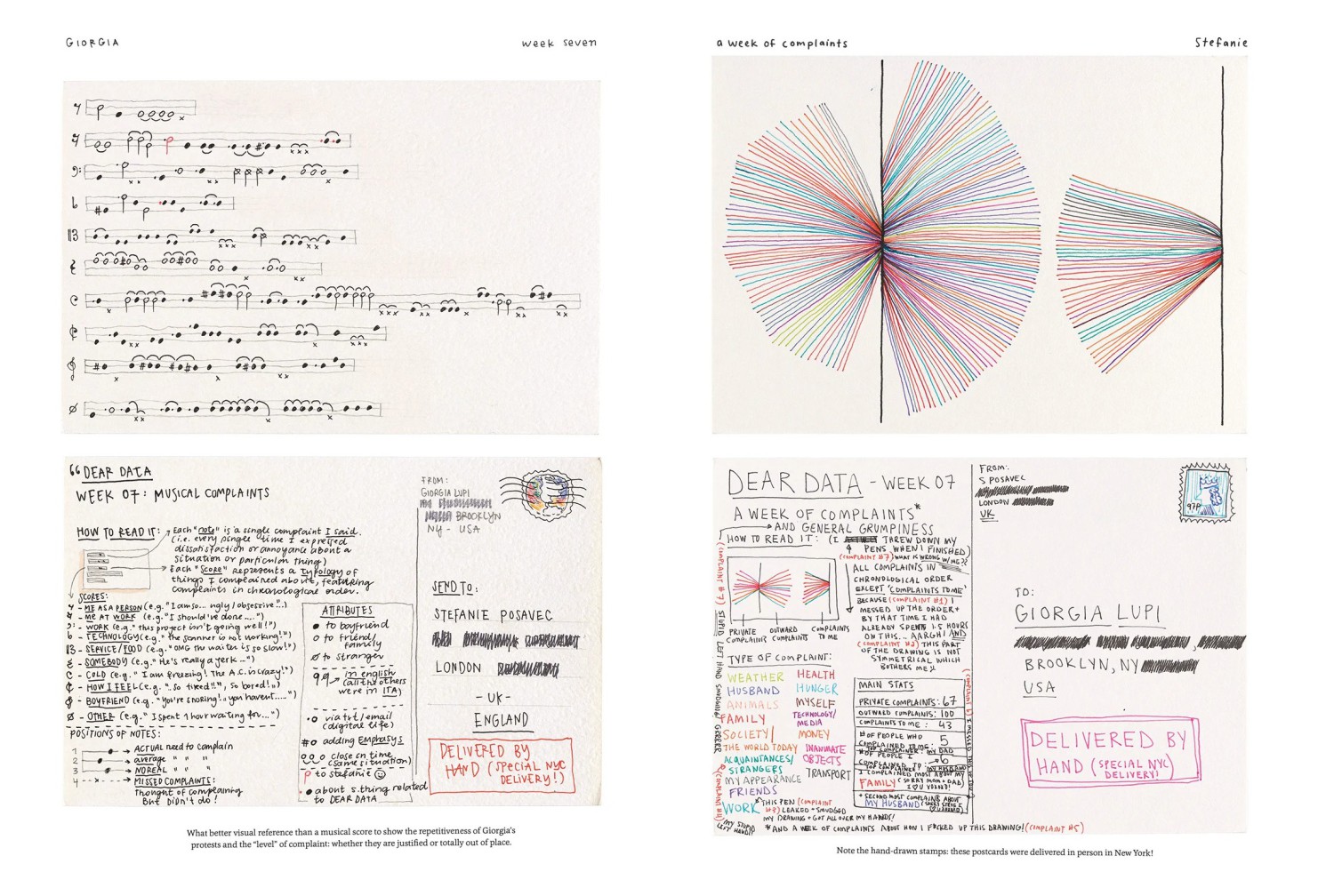
Giorgia Lupi
In a blog post for Medium, Lupi says that "dense and unconventional data visualizations promote slowness — a particularly poignant goal to set in our era of ever- shortening attention spans". Upon first glance, neither of these visualizations above can be understood, but once you spend time with it, patterns and interesting conclusions are drawn. In the same article, she speaks on the method of data collection: “We shouldn’t expect an app to tell us something about ourselves without any active effort on our part; we have to actively engage in making sense of our own data in order to interpret those numbers according to our personal story, behaviors and routine.”
Data must be nuanced and an artificial intelligence is not smart enough to understand human subtleties. I take Lupi’s philosophy alongside me now and try to use it in my own art practice to better understand the world, as other methods of learning have.